
We are a community for people with lived experience of mental health to campaign for change.
Members of the Independent Mental Health Network in North Somerset, South Gloucestershire and Bristol are currently working on a project to improve support and care pathways for those experiencing a mental health crisis in the local area.
In order to investigate how this support can be improved, we have launched a survey asking about peoples’ experiences and views about apps that aim to support and improve mental health and wellbeing.
Mobile phone apps can be used by people experiencing a mental health crisis. Sometimes, information about apps can be shared by mental health professionals.
The survey can be found by clicking the following link: surveymonkey.co.uk/r/MentalHealthApps.
We are encouraging people with all kinds of lived experience of mental health, including people that support those with mental health difficulties, to take visit and take part in the survey.
February 24, 2020 at 2:22 pm
Thank you to everyone that attended the Summit. You can keep up to date with our work in this area here.
In partnership with civic and healthcare authorities across Bristol, North Somerset and South Gloucestershire, the Independent Mental Health Network (‘IMHN’) are proud to announce the upcoming Suicide Prevention Summit.
The Summit will take place as part of the Shine On Suicide Prevention Campaignon Monday 13 January 2020 at City Hall, College Green Bristol.
The aim of the Summit will be to agree a clear call-to-action on working together to prevent suicide, providing space and opportunities for both people with lived experience of mental health, and from within wider communities, to help shape this.
IMHN CEO Tom Renhard, said:
“We feel it is vital to be creating spaces for community groups and individuals with lived experience that are leading the fight to prevent suicide and self-harm across Bristol, North Somerset and South Gloucestershire, to come together and play a crucial role in how this work develops.
We are supporting a wider regional ambition to reduce the number of people taking their own lives and doing that requires a grassroots approach as well as support from senior leadership. One life lost is one too many, and there is plenty for us all to do to ensure people know there is support available out there and play a role in improving things for the future.”
Cllr Asher Craig, Deputy Mayor and Bristol City Council Cabinet member for Communities, said:
“It is vital that we work with other organisations to help prevent suicide by offering the right support at the right time to those who need it.
“Of equal importance is listening to people who have felt suicidal, and to the families and communities that have been impacted by suicide. This lived experience can help us shape mental health services and ensure no one in Bristol is unsupported.’’
Bristol, North Somerset and South Gloucestershire Clinical Commissioning Group (‘BNSSG CCG’) will be sharing details of the all-age mental health strategy currently being developed for the area, which will be published in 2020.
Julia Ross, Chief Executive Officer of BNSSG CCG, said:
“Suicide is preventable rather than inevitable, and every person that takes their own life is one too many.
We are delighted to be working with people and partners across the area, including those with lived experience of mental ill health and self-harm, to tackle this together. Creating the right support network for people at risk of suicide requires a combined effort – from the NHS, councils, community and voluntary groups, families and others.
The summit will play a key role in joining this up, so that people can get the support they need, when they need it.”
The event programme will also consider the latest research into suicide prevention, work happening nationally, and a focus on initiatives and stories by people in the local area. We will also be inviting attendees to share their experiences and ideas about suicide prevention, stating what role communities should be playing in this work going forwards.
Because of the range of individuals and organisations expected to attend, spaces are limited. Please visit to book an individual free place.
Please direct any queries to engagement[@]imhn.org.
What is the Shine On Campaign?
Shine On is a campaign focussing on suicide prevention across the Bristol, North Somerset and South Gloucestershire, tackling suicide via a variety of initiatives; including a community grant scheme, the Suicide Prevention Innovation Fund.
The campaign is delivered by a partnership of organisations including Bristol, North Somerset & South Gloucestershire Clinical Commissioning Group, Bristol City Council, North Somerset Council, South Gloucestershire Council, Community Access & Support Service (CASS), Second Step, and the Independent Mental Health Network (IMHN).
What is the Independent Mental Health Network (IMHN)?
IMHN is a member-led organisation that work both for and in the interests of people with lived experience of mental health. We support work improving local mental health services, contribute and campaign on mental health matters happening both locally and nationally, and actively challenge mental health stigma by working with partner organisations.
Why is the Shine On campaign, and the Summit being run for the Bristol, North Somerset, and South Gloucestershire area?
In 2017, NHS England allocated an amount of money to address the higher than average suicide rate in the Bristol, North Somerset and South Gloucestershire area. This fund is managed by the BNSSG Suicide Prevention Transformation Fund Working Group, and funds initiatives such as Second Step’s Hope Project, local campaigning and awareness raising, and more. This Working Group is supporting IMHN in delivering this campaign.
Who are the partners of the campaign?
This campaign is supported by the Bristol, North Somerset and South Gloucestershire Suicide Prevention Transformation Working Group. The Working Group is a partnership of local organisations that aim to address the higher-than-average rate of suicide across the local area. The group consists of:
Where Can I Get More Information?
December 20, 2019 at 7:09 pm
Please note that this guide was put together for the December 2019 to January 2020 festive period. The information contained within the guide may now be out of date.

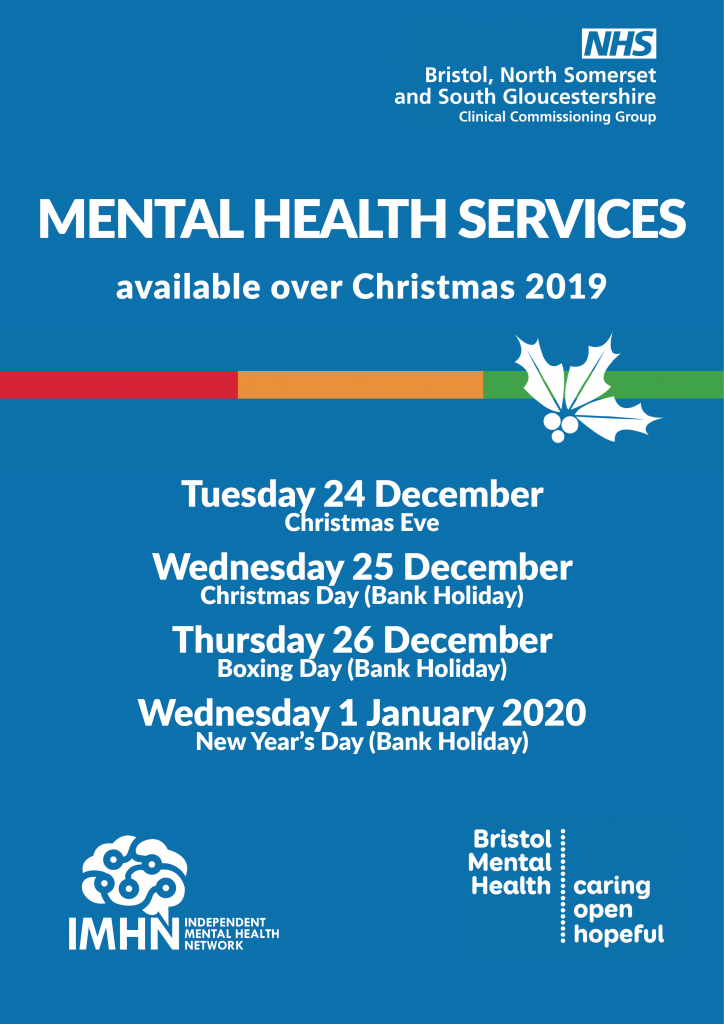
The Independent Mental Health Network (IMHN) have produced a guide outlining the services providing wellbeing and mental health support available to people in the Bristol, North Somerset and South Gloucestershire period over the Christmas 2019 and New Year 2020 period. This follows on from the success of last year’s guide in helping people and communities navigate what is available at this time of this year.
After compiling this guide for the Bristol area for a number of years, and in response to feedback and requests from a large number of organisations and individuals, we are pleased to include details of appropriate services for the South Gloucestershire and North Somerset area in this year’s guide.
The guide lists mental health and wellbeing support available over the seasonal period, making note of any changes to opening or operating times, and contact details. It brings together information about mental health support from both NHS and voluntary & community sector partners that can be accessed.
Where a service is available to individuals living in either Bristol, North Somerset, or South Gloucestershire, the service will be listed under all three sections.
The guide also lists national helplines.
IMHN CEO, Tom Renhard, said:
“The festive season, whilst a time of celebration and relaxation for many, can be difficult for some. Many people may feel increasingly isolated at this time of year, or may be struggling with their mental health and wellbeing for a variety of reasons.
We are pleased to produce this guide for the fourth year in a row, aiming to assist people right across the Bristol, North Somerset and South Gloucestershire area in accessing the right support at the right time, should they need to.
The guide has been drafted to help people find the right information quickly, and has been shared with local organisations and charities. We would encourage you to share the guide with anyone you think might benefit from reading it.”
Click the image below to access the guide. Alternatively, the download link for the guide (in .pdf format) can be found here.
December 17, 2019 at 5:08 pm

Content headnote: this article references mental health in a variety of contexts, including but not limited to mental health treatment; discrimination; medication; conditions; out-of-area placements; crime; trauma; and suicide.
This post intends to provide a factual and straightforward re-statement of pledges and commitments relating to mental health and mental health care contained within the manifestos of each of the eight largest political parties (by candidates fielded) participating in the United Kingdom’s General Election in December 2019. It does not intend to assess, criticise, prioritise or appraise the individual or collective policies or positions of any or all of the parties included.
The information contained in this article does not reflect the views of the Independent Mental Health Network, which does not endorse political organisations. The information reported on below is correct and up to date as of Tuesday 10 December 2019.
Please note: each section below covers the content of a particular Political Party’s manifesto. These sections are randomised; this means that each time this webpage is loaded or reloaded, they will appear in a different, randomised order.
The Liberal Democrat manifesto makes a number of references to the party’s belief that it is important for mental health to receive the same priority as physical health. The party’s top-line commitment for mental health services is £11bn throughout the course of the next Parliament, in order to ‘increase access to therapies’ and the number of specialists delivering them. A commitment is made to ring-fence revenue from a planned income tax rise to invest in mental health generally.
More specific areas of action include:
Social initiatives include related to mental health, wellbeing and culture include:
Condition-specific measures include:
The Liberal Democrats do not mention nursing recruitment or tuition fees in their manifesto.
As part of the Conservative Party’s commitment to provide 50,000 more nurses for public health services, they propose an annual maintenance grant scheme for nurses in training, with further funding available for those pursuing qualifications in mental health-specific disciplines.
The manifesto states a commitment that mental health will be prioritised as urgently as physical health is.
Legislation will be introduced giving patients ‘greater control’ over the mental health treatment they receive.
The SNP refer to mental health in their manifesto when discussing migration and immigration. The party states its opposition to detaining people with mental illnesses.
In the party’s plans to prevent children suffering online harm, the SNP intend to introduce a statutory duty of care and mandatory obligations upon technology, gaming and social media companies, that will require them to tackle unsuitable content that can lead to self-harm and suicide appearing on their platforms
The SNP commit to no tuition fees in Scotland. The party do not mention the nursing profession or plans for funding and support of nurses in training in their manifesto.
The Brexit Party have published a ‘Contract with the People’ in place of a manifesto. The party’s Contract with the People does not refer to or discuss matters related to mental health, or funding of education of nurses.
The party pledges to remove the degree requirement for nursing professions, whilst introducing a nursing qualification in social care.
Plaid Cymru’s manifesto discusses the value the party places on the parity of esteem between mental and physical health services within the NHS. They pledge to provide a 5% cumulative increase on mental health expenditure every year for the next decade.
More specific areas of action include:
Plaid Cymru pledge to create a Community NHS Rehabilitation Service, with medical professionals including therapists and Mental Health Counsellors, which will be responsible for follow-up treatments of patients and supporting independent living.
Additionally, during discussion of plans for prisons, support for the victims of crime, and support for veterans; Plaid Cymru mention the importance of recognising the factor and impact that mental health can have on people in these situations.
UKIP’s manifesto pledges to introduce practical policies to improve the delivery of mental health services and increase mental health funding, ‘as necessary.’
The party intends to investigate the causes of mental health problems so that they may tackle them at source and be ‘proactive’ in public health campaigns to encourage people to take responsibility for better care of their health.
UKIP plan to increase the number of training places for British nurses, in order to provide 40,000 extra nurses. To support nurses in training, student bursaries will be re-introduced for nursing and midwifery students. The party also plans to change the way the nurses become qualified, providing an alternative for nurses to qualify other than via degrees. UKIP plans to reintroduce State Enrolled Nurses, and recruitment of nurse associates and assistant practitioners via apprenticeship schemes.
Labour pledge to allocate an additional £1.6 billion to address the lack of parity of esteem between the treatment of mental and physical health conditions. In addition to this, a £2 billion investment is pledged to modernise mental health treatment facilities in hospitals, and to ‘end…out-of-area placements.’
The manifesto outlines a £845 million plan to double the annual spending on Children and Adolescent Mental Health Services (‘CAMHS’) and recruit 3500 counsellors for schools in order to support the mental health of young people.
More specific areas of action include:
The Green Party manifesto states an intention to ‘widen and enhance’ the services provided by the NHS, including fit-for-purpose mental health services. They intend to focus funding on improving mental health care in order to put it on an ‘equal footing’ with physical health.
The party intends to reduce wait times for accessing evidence-based therapies to within 28 days.
The Green Party intends to scrap tuition fees and allocate a further £1 billion a year to nursing higher education, allowing nursing bursaries to be reinstated.
The party will also reinstate the Health Secretary’s duty to ensure there are enough health and care staff (including nursing) to meet the needs of the population.
The manifesto states that specific mental health provision will be made for LGBTIQA+ individuals and BME communities, children, adolescents, and older people. Mental health care also forms part of the Green Party’s plans to tackle discrimination with LGBTIQA+ and BME communities.
The research and development of psychoactive drug-based treatments for mental health conditions also forms part of the Green Party’s drug policy.
December 11, 2019 at 8:46 am